def sum(first, second):
result = first + second
return result
What is the output of this function given the choices below?
- 0
- 1
- 2
- 3
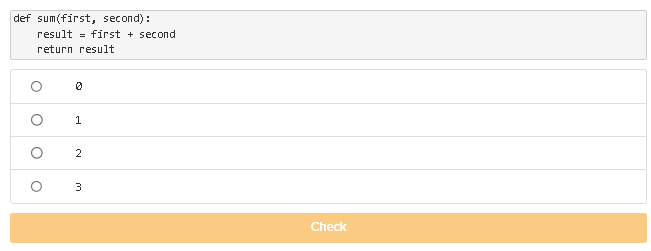
def sum(first, second):
result = first + second
return result
What is the output of this function given the choices below?
To determine the output of the function `sum(first, second)`, we need specific values for `first` and `second`. However, since these values aren’t provided, we can’t identify a definite output.
If we consider the function and run it with different pairs of numbers:
– For example, if `first = 1` and `second = 2`, the output would be `1 + 2 = 3`.
– If `first = 0` and `second = 0`, the output would be `0 + 0 = 0`.
Without specific inputs, we can’t select one of the choices directly. If you have a particular example in mind or any inputs you’d like to test, please share them, and I can help further!
If you need more detailed assistance, please check the extended services page.
print(sum(1, 2))
The result will be 3 because:
result = 1 + 2