Question & Answer

Comparing Average Rates of Change for Functions f(x) and g(x) Over an Interval

Comparing Average Rates of Change for Functions f(x) and g(x) Over an Interval

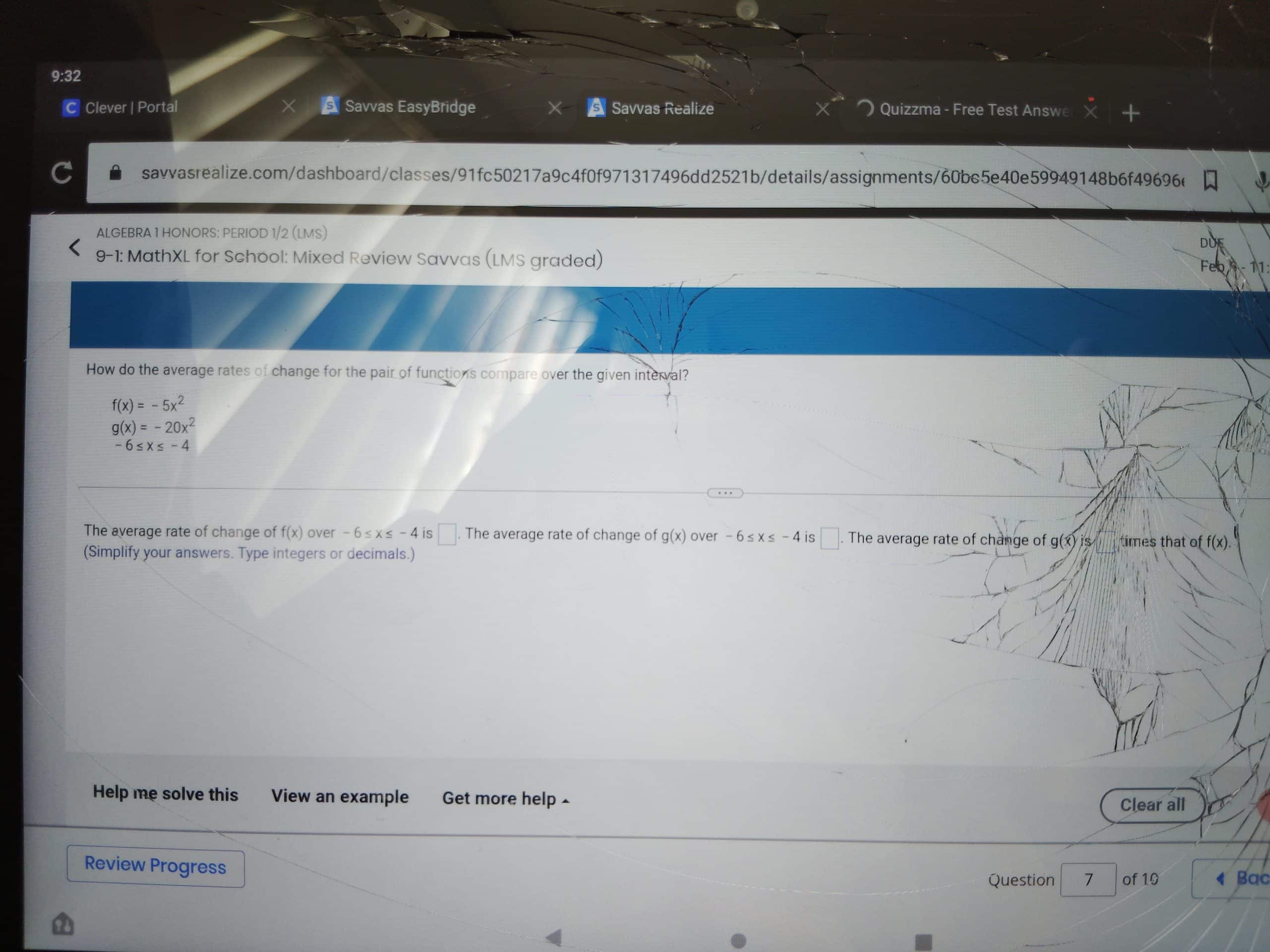
How do the average rates of change for the pair of functions compare over the given interval?

The average rate of change of f(x) over -6 ≤ x ≤ -4 is __. The average rate of change of g(x) over -6 ≤ x ≤ -4 is __. The average rate of change of g(x) is __ times that of f(x). (Simplify your answers. Type integers or decimals.)

2 Answers

Verified archive
Quizzma TeamFebruary 4, 2025

To find the average rates of change of the functions ( f(x) ) and ( g(x) ) over the interval ([-6, -4]), you can use the formula for the average rate of change:

[

text{Average Rate of Change} = frac{f(b) – f(a)}{b – a}

]

where ( a ) and ( b ) are the endpoints of the interval.

1. Calculate the average rate of change for ( f(x) ):

– Let’s assume you calculated ( f(-6) ) and ( f(-4) ).

– Substitute those values into the formula to find the average rate of change for ( f(x) ).

2. Calculate the average rate of change for ( g(x) ):

– Similarly, calculate ( g(-6) ) and ( g(-4) ).

– Substitute these values into the formula to find the average rate of change for ( g(x) ).

3. Compare the average rates of change:

– To find how many times the average rate of change of ( g(x) ) is compared to ( f(x) ):

[

text{Comparison Factor} = frac{text{Average Rate of Change of } g(x)}{text{Average Rate of Change of } f(x)}

]

After performing these calculations, you will complete the statement with

Quizzma TeamFebruary 4, 2025

To find the average rates of change for the functions ( f(x) ) and ( g(x) ) over the interval ([-6, -4]), we use the formula:

[

text{Average Rate of Change} = frac{f(b) – f(a)}{b – a}

]

where ( a = -6 ) and ( b = -4 ).

1. Calculate the average rate of change for ( f(x) ):

– Compute ( f(-6) ) and ( f(-4) ).

– Plug these values into the formula.

2. Calculate the average rate of change for ( g(x) ):

– Compute ( g(-6) ) and ( g(-4) ).

– Use the same formula as above.

3. Compare the average rates:

– Divide the average rate of change of ( g(x) ) by that of ( f(x) ).

Once you have ( f(-6) ), ( f(-4) ), ( g(-6) ), and ( g(-4) ), substitute these into the formula and calculate the results.

If you provide the values of ( f(-6) ), ( f(-4) ), ( g(-6) ), and ( g(-4) ), I can help you further with the calculations!